Okteto vs Qovery: Choosing the Right Kubernetes Development Platform for Your Team

The development platform you choose shapes how your entire engineering organization works, not just today, but as you scale. So the question isn't just which platform has the right features. It's which platform is built around the right philosophy for how your team works. Do you need infrastructure automation, or developer velocity? Deployment simplicity, or faster iteration? Okteto and Qovery answer these questions differently. This guide explains how.
Understanding the Shared Challenge
Modern cloud-native development is complex. Your applications aren't just code anymore. They're code plus configuration, runtime dependencies, network policies, secrets, and interactions across dozens of microservices. Developers can't gain real confidence that their changes work by running unit tests on a laptop. They need access to realistic environments that reflect production complexity.
Both Okteto and Qovery recognize this challenge. Both aim to give developers better environments than local development that can't match production's complexity. But they approach the problem from different starting points, and those starting points shape everything about how each platform works.
How Qovery Works
Qovery positions itself as a DevOps automation platform. Its core promise is to give teams Heroku-like simplicity while running on their own cloud infrastructure. When you use Qovery, the platform provisions complete, standalone copies of your infrastructure for each environment: development, staging, production.
This approach has clear appeal. Teams migrating from Heroku or Elastic Beanstalk get a familiar abstraction layer. Organizations without deep Kubernetes expertise can deploy to Kubernetes without learning Kubernetes. The platform handles infrastructure provisioning and deployment, prioritizing abstraction over daily developer experience.
Qovery's architecture creates full infrastructure copies for each environment. For example, when you spin up a preview environment, you get a complete replica of your services, databases, and dependencies. This provides high fidelity but comes with tradeoffs: longer spin-up times (minutes rather than seconds), higher infrastructure costs (full resource duplication per environment), and costs that scale linearly with environment count. You'll also need to translate your existing deployments into Qovery's configuration model rather than using your native Kubernetes manifests.
The focus is on deployment automation and infrastructure abstraction. Qovery aims to eliminate the need for DevOps expertise by handling the complexity behind a simplified interface.
How Okteto Works
Okteto takes a different architectural approach, starting from a different premise about what developers actually need.
Instead of creating infrastructure copies, Okteto runs your development process directly in Kubernetes, in actual pods within your cluster. When you develop with Okteto, your code executes in the same runtime environment where it will eventually run in production: same service accounts, same environment variables, same security configurations, same volumes, same sidecars. Changes sync in real-time, with feedback loops measured in seconds rather than minutes.
But the deeper difference isn't just architecture. It's philosophy.
Okteto is built on the premise that different environment types exist to serve different workflows and use cases, and a platform should be optimized for each workflow's specific job. A dev environment isn't a small staging environment. A preview environment isn't a temporary production replica. Each environment class has a distinct purpose and requires distinct capabilities.
This "environments have different jobs" philosophy shapes everything about how Okteto works:
Dev Environments are optimized for iteration speed. Real-time file sync, hot reload, bidirectional synchronization, remote debugging, port forwarding for IDE integration, and volume snapshots to quickly restore state. The job is all about helping individual developers move fast.
Preview Environments are optimized for collaboration and validation with auto-deploy on pull requests, shareable URLs and automatic cleanup on merge. The job is enabling PMs, designers, QA, and stakeholders to validate changes before they're merged, without any technical setup required.
Test Environments are optimized for consistency and reliability. Tests run inside the Kubernetes cluster, not on a separate CI virtual machine. They have the same runtime as production, access to private services and reduced latency. The job is ensuring your entire pipeline, from dev through CI, runs on Kubernetes to eliminate "works in CI but not in prod" surprises.
Agent Environments give AI coding agents a place to build, test, and validate code. AI agents need production context the same way developers do. They need safe, secure, production-like environments to build, deploy, and verify code end-to-end, not just suggest changes. Each agent gets its own isolated, ephemeral environment with full access to code, infrastructure, and tests. The job is enabling teams to run fleets of agents in parallel, each working independently on different tasks, with the security and observability enterprise teams require.
Quick Comparison
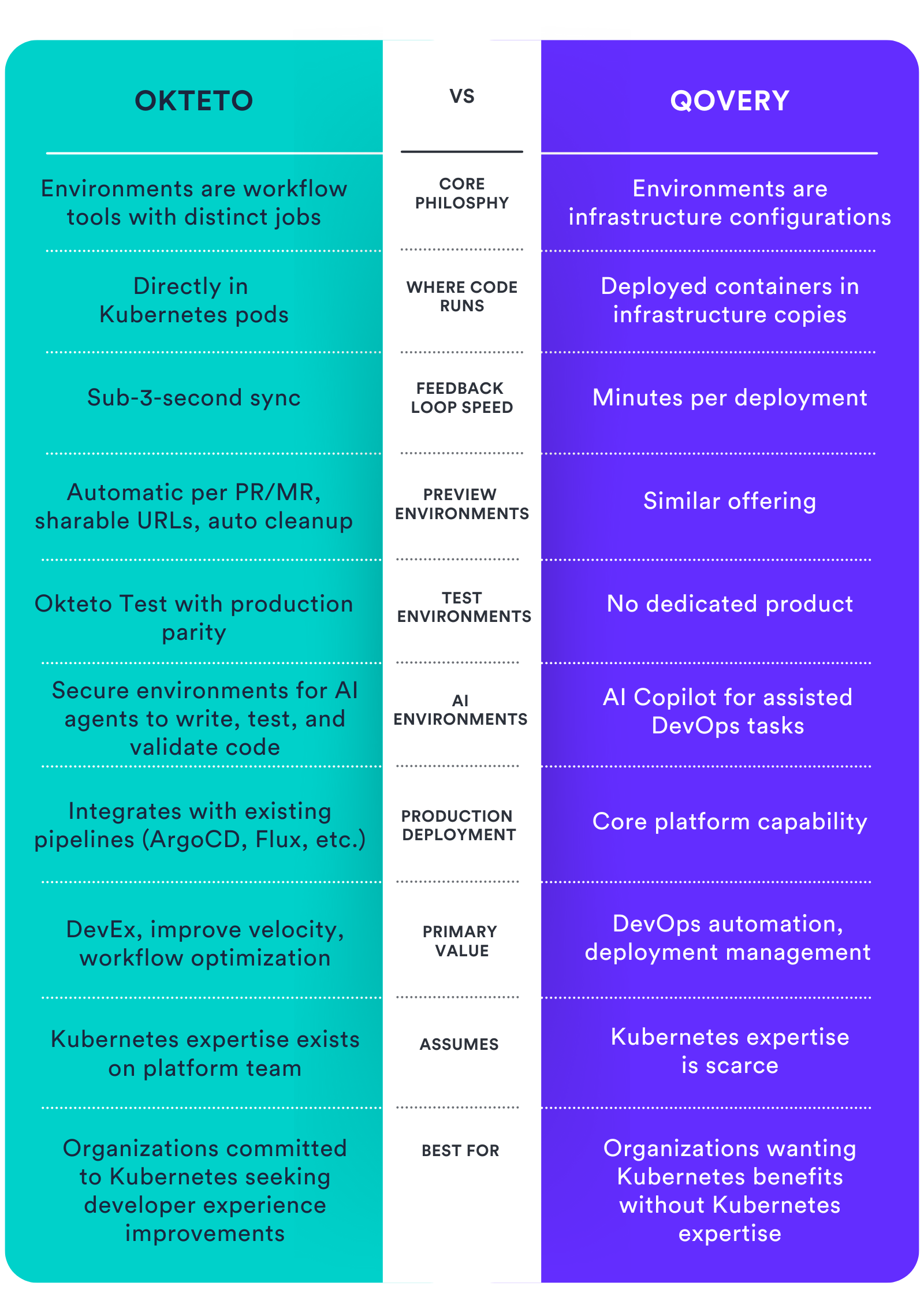
The table shows what each solution offers. The rest of this guide explains why those differences matter for your decision.

The Philosophical Divide
Here's the core distinction that explains most of the differences between these platforms:
Qovery takes a generic approach to environments. Every environment is an infrastructure copy with different sizing and lifecycle rules. This works if your needs are straightforward, but it means the platform can't optimize for what each workflow actually requires.
Okteto takes a purpose-built approach. Each environment type is designed around its specific job because those jobs are fundamentally different.
The result isn't more complexity for developers. It’s that developers (and PMs, QA, agents, etc.) get better outcomes because the environment is optimized for what they're actually trying to accomplish, rather than forcing everyone to use a generic infrastructure copy.
Architecture Matters: Where Your Code Actually Runs
The philosophical difference manifests in a concrete technical distinction: where your code actually runs during development.
With Qovery, you get a complete, isolated replica of your services, but you're working with deployed containers, not an interactive development experience.
With Okteto, your development process runs in actual Kubernetes pods, inheriting your production configuration automatically. You're not developing in something that looks like production. You're developing in production's twin.
This matters for several reasons:
You get true production parity
Okteto eliminates the "works on my machine" problem at the root. If it works in your dev environment, it works in production, because they're the same runtime. Integration issues surface during development, not after deployment. Configuration drift between environments disappears because there's only one environment configuration.
Your Feedback Loops Drop to Seconds
Code changes sync in under 3 seconds. You write code, save the file, and see results immediately. Developers aren't waiting on container builds, image pushes, or long deployments. Seconds vs. minutes adds up. A developer iterating 50 times a day saves over 2 hours with a 3-second loop instead of a 3-minute deploy. Multiply that across your team and the year, and you're recovering thousands of engineering hours.
You Debug Directly in Kubernetes
Attach your IDE's debugger directly to code running in Kubernetes, setting breakpoints, inspecting variables, and stepping through execution against realistic services and data. Instead of adding log statements, redeploying, and waiting, you can pause execution and inspect state in real time. You're debugging against actual dependencies, actual data flows, and actual network conditions. For complex bugs that only manifest in production-like environments, this cuts investigation time dramatically.
Your Costs Don't Scale Linearly
Environments share cluster resources intelligently, so costs don't scale linearly with team size. With infrastructure-copy approaches, ten developers mean ten full environment replicas, and fifty developers mean fifty. Okteto's architecture lets teams share baseline resources while isolating only what each developer is actively changing. The result is predictable costs that don't balloon as your team grows.
Platform Engineering Enablements
For platform engineering leaders, the question isn't just "which tool helps developers code faster?" It's "which platform helps me build and scale a developer experience function?"
Okteto provides the infrastructure platform teams need:
Okteto Insights gives you visibility into your developer experience by tracking build duration trends, deploy times, test success rates, and platform adoption metrics. This is the data you need to understand how your platform serves developers and where to improve.
Okteto Catalog lets platform teams define standardized, compliant environment templates. Developers get self-service access to approved configurations, and platform teams maintain governance without becoming a bottleneck.
Resource Manager provides cost visibility and optimization across namespaces, while Garbage Collector sets sleep and delete policies for automatic cleanup. Know what you're spending, where to optimize, and let smart policies handle the rest.
Unified manifest with build, dev, test, and deploy sections provides consistent governance across all environment types. One configuration model for your entire development lifecycle.
Enterprise readiness: SSO, RBAC, audit logs, and the compliance features (SOC 2 Type 2) that enterprise organizations require.
Choosing the Right Platform for Your Team
Both platforms solve real problems. The right choice depends on your organization's context, not which platform has more features.
Okteto fits best if:
- Your organization has already committed to Kubernetes and is experiencing developer productivity pain
- You want developers working in environments that truly mirror production to eliminate environment skew
- You need to support different workflows for different teams (dev velocity, stakeholder review, test reliability)
- You're building or scaling a platform engineering function
- You have existing production deployment pipelines and need a solution that integrates rather than replaces
- You care about enabling your entire product team, not just developers
- You want visibility into platform adoption and developer productivity metrics
Qovery may fit if:
- You're building greenfield infrastructure without existing Kubernetes expertise
- You want a single vendor for dev through production because infrastructure management is your primary pain point, not developer velocity
- You're migrating from Heroku or similar PaaS and want familiar abstractions
The Platform Engineering Perspective
If you're a platform engineering leader evaluating these solutions, here's the strategic question: Are you trying to automate infrastructure, or are you trying to accelerate your entire product team?
Qovery answers the first question. It automates DevOps so you don't have to hire for it. That's valuable for organizations at a certain stage.
Okteto answers the second question. It gives developers sub-3-second feedback loops, gives PMs and designers shareable preview URLs, gives QA on-demand test environments, and gives you the visibility to continuously improve. It treats each workflow stage as a distinct problem worth solving well.
If your organization has committed to Kubernetes and your constraint is developer velocity, not deployment automation, Okteto is purpose-built for that outcome.
See the Difference
Ready to see how purpose-built development environments can accelerate your team?
Our team has helped organizations from 20 to 2,000+ developers build platforms that actually scale. We'll walk through your specific environment strategy and show you how Okteto fits your development process.